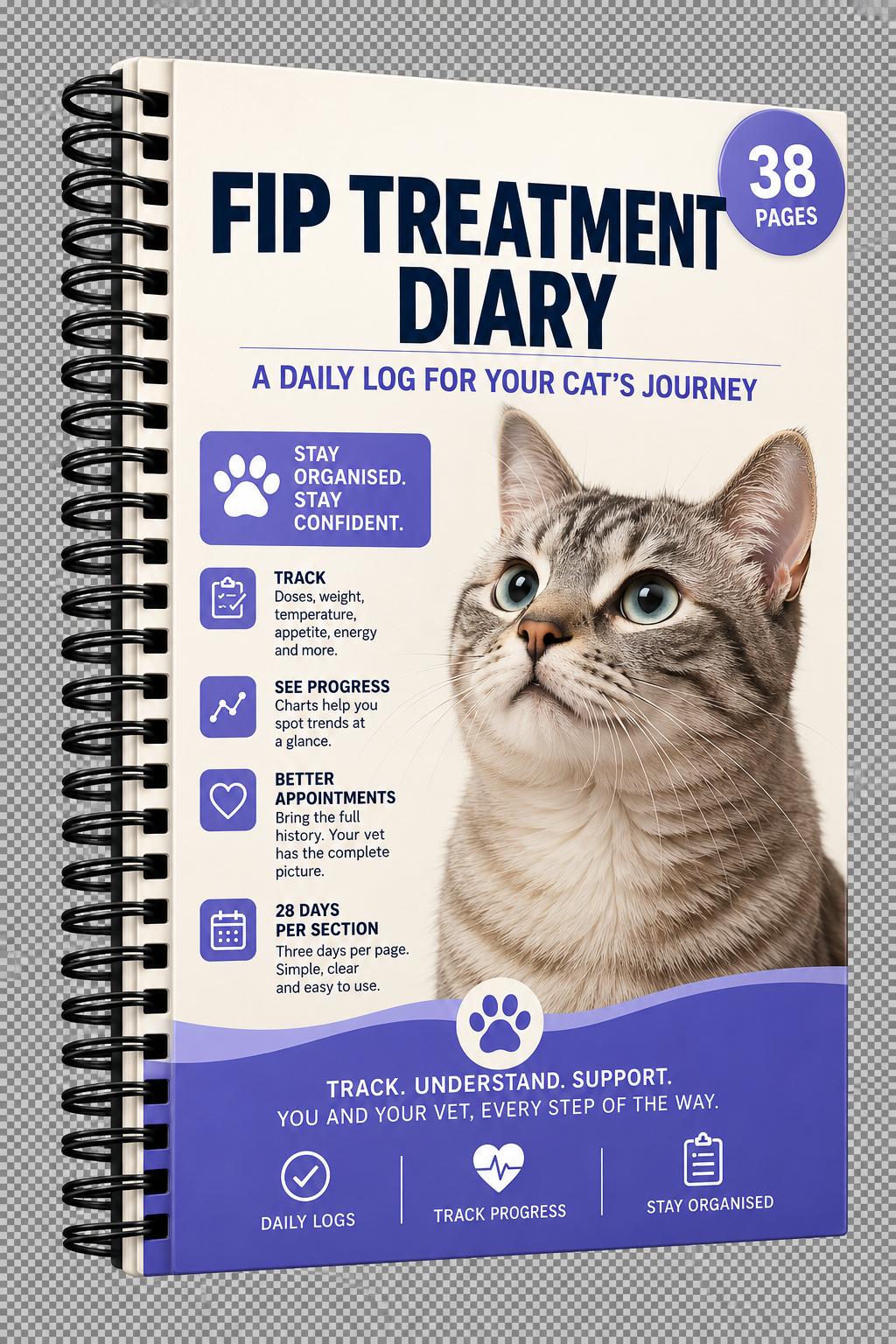
Why keep it on paper
Between doses, weigh-ins, temperature readings and bloodwork there is a lot to hold in your head, at a time when you are already worried. Most of it ends up scattered: a note in a phone, a photo of a lab report, a figure someone half-remembers at the next appointment.
A vet who can see the full history makes better decisions than one relying on what the owner recalls. That is the whole argument for writing it down in one place.
What's inside
Every page is a form to complete, not a page to read.
- Cat profile — baseline details, diagnosis, contacts, and the symptoms present at the start so you can follow how they change
- Dosing table — blank fields for your vet to complete, so the amount matching the current weight is always within reach
- 28 pages of daily log — three days per page: time and amount given, weight, temperature, appetite, energy, breathing, free notes
- Weight and temperature trends — plotting grids plus tables of readings, so the direction of travel is visible at a glance
- Bloodwork — twenty parameters across six check-ups on a single spread, instead of a folder of loose reports
- Observation period — the weeks after the final dose, and space for the signs your vet tells you to watch for
- Questions for your vet — noted before the appointment, answers written alongside
Made to be used, not admired
Four decisions that came from actually filling one in.
Three days per page
Enough room to write by hand without carrying a folder of loose sheets to every appointment.
Both paper sizes
A4 and US Letter included. Printing an A4 on Letter paper crops the margins, which is exactly the sort of detail that ruins a printable.
No app, no account
Two PDF files. Nothing syncs, nothing expires, nothing needs a login at three in the morning.
Typeset, not templated
Ruled rows, real writing space, checkboxes sized for a pen rather than a cursor.
What this is not
This is a log to fill in. It contains no dosages, no treatment protocols and no clinical recommendations, and it does not replace diagnosis or instructions from a veterinarian.
That is deliberate. Dosing depends on the form of FIP, on weight and on individual response, and no printed document can — or should — make that call. What a printed document can do is make sure nothing gets lost along the way.